
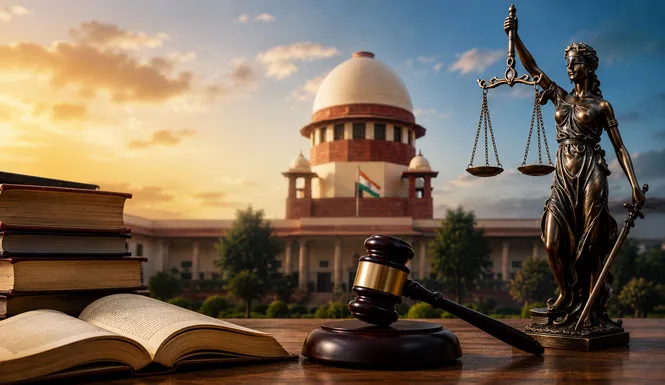
For every law student, understanding these landmark constitutional cases is essential not only for academic purposes but also for understanding how constitutional democracy survives in practice.
Kesavananda Bharati v. State of Kerala, (1973) 4 SCC 225
The decision in Kesavananda Bharati is widely regarded as the most important judgment in Indian history. The case arose during a prolonged conflict between Parliament and the judiciary over the extent of Parliament’s power to amend the Constitution. Earlier cases like Shankari Prasad, Sajjan Singh, and Golaknath had already created deep controversy regarding whether Parliament could amend Fundamental Rights.
In Kesavananda Bharati, a thirteen-judge bench of the Supreme Court held that while Parliament possesses wide powers to amend the Constitution under Article 368, it cannot alter or destroy the “basic structure” of the Constitution. The Court did not provide an exhaustive definition of the doctrine, but over time it came to include principles such as democracy, secularism, federalism, judicial review, rule of law, and separation of powers.
The judgment fundamentally changed Indian constitutional law by establishing constitutional supremacy over parliamentary supremacy. It ensured that even a massive political majority could not legally dismantle the essential identity of the Constitution.
A.K. Gopalan v. State of Madras, AIR 1950 SC 27
A.K. Gopalan was one of the earliest cases decided by the Supreme Court after the Constitution came into force. The Court adopted a highly narrow and textual interpretation of Fundamental Rights. It held that each fundamental right existed independently and that Article 21 merely required a “procedure established by law,” regardless of whether that procedure was fair or reasonable.
The judgment gave wide powers to the State in matters of preventive detention and limited judicial scrutiny of executive action. Though the reasoning in Gopalan was later substantially diluted, the case remains significant because it reflects the early conservative phase of constitutional interpretation in India.
The constitutional transition “From Gopalan to Gandhi” as one of the defining shifts in Indian constitutional jurisprudence.
Maneka Gandhi v. Union of India, (1978) 1 SCC 248
If Gopalan represented the restrictive phase of constitutional interpretation, Maneka Gandhi represented its transformation into a rights-oriented constitutional order. The case arose when the government impounded Maneka Gandhi’s passport without providing proper reasons.
The Supreme Court held that any law affecting personal liberty under Article 21 must be “just, fair and reasonable.” The Court rejected the earlier narrow interpretation of Article 21 and held that Articles 14, 19, and 21 are interconnected.
This judgment revolutionized constitutional law in India. It expanded the scope of personal liberty and laid the foundation for numerous implied rights under Article 21, including the right to dignity, legal aid, livelihood, education, privacy, and clean environment. The decision effectively introduced substantive due process into Indian constitutional jurisprudence.
ADM Jabalpur v. Shivkant Shukla, (1976) 2 SCC 521
The ADM Jabalpur case, popularly known as the Habeas Corpus Case, is remembered as one of the darkest moments in Indian judicial history. During the Emergency imposed in 1975, the question before the Supreme Court was whether citizens could seek judicial remedy for unlawful detention when Fundamental Rights were suspended.
The majority of the Court held that during the Emergency, even the right to approach courts for enforcement of personal liberty could be suspended. The judgment effectively placed executive power above individual liberty during a constitutional crisis.
However, Justice H.R. Khanna’s dissent became legendary. He said that liberty is not merely a constitutional privilege but an inherent human right that survives even in the absence of constitutional protection. Justice Khanna’s dissent is a defining contribution to the protection of personal liberty. Today, the majority opinion is widely condemned, while Justice Khanna’s dissent is celebrated as one of the finest moments of judicial courage in India.
Indira Nehru Gandhi v. Raj Narain, 1975 Supp SCC 1
This case emerged after the election of Prime Minister Indira Gandhi was challenged before the Allahabad High Court. Parliament attempted to protect the election from judicial scrutiny through a constitutional amendment.
The Supreme Court struck down the amendment and held that free and fair elections are part of the basic structure of the Constitution. The judgment reinforced the principle that democracy and judicial review cannot be destroyed even through constitutional amendments. The case became a major reaffirmation of constitutional supremacy during one of the most politically turbulent periods in India’s history.
Minerva Mills v. Union of India, AIR 1980 SC 1789
The Minerva Mills judgment further strengthened the Basic Structure Doctrine established in Kesavananda Bharati. The Court struck down portions of the 42nd Constitutional Amendment that attempted to give unlimited amending powers to Parliament.
The Supreme Court held that limited amending power itself forms part of the basic structure of the Constitution. The judgment also emphasized that harmony between Fundamental Rights and Directive Principles is an essential constitutional feature. The decision restored constitutional balance after the Emergency period and reaffirmed the judiciary’s role as guardian of constitutional limitations.
S.R. Bommai v. Union of India, (1994) 3 SCC 1
The S.R. Bommai judgment significantly strengthened Indian federalism and constitutional democracy. The Supreme Court examined the misuse of Article 356, under which state governments were frequently dismissed by the Union government.
The Court held that secularism is part of the Constitution’s basic structure and that the imposition of President’s Rule is subject to judicial review. This judgment prevented arbitrary misuse of central power and reinforced constitutional federalism. The decision remains one of the strongest judicial affirmations of democratic accountability in India.
Justice K.S. Puttaswamy v. Union of India, (2017) 10 SCC 1
In Puttaswamy, a nine-judge bench of the Supreme Court unanimously recognized the Right to Privacy as a Fundamental Right under Article 21. The judgment held that privacy is integral to dignity, autonomy, and personal liberty. It expanded constitutional protection in areas relating to bodily integrity, informational privacy, decisional autonomy, and digital freedoms.
Navtej Singh Johar v. Union of India, (2018) 10 SCC 1
The Supreme Court in Navtej Singh Johar partially struck down Section 377 of the Indian Penal Code and decriminalized consensual same-sex relations between adults. The judgment emphasized constitutional morality over social morality and recognized the constitutional values of dignity, equality, identity, and privacy. The Court acknowledged that constitutional rights cannot depend upon majoritarian approval.
The evolution of constitutional law in India is ultimately the story of a continuous struggle between power and liberty. These landmark judgments demonstrate how constitutional courts have protected democratic values, restrained arbitrary authority, and expanded the meaning of rights over time.
For law students, these cases are not merely precedents to memorize. They are constitutional milestones that explain how India’s democracy has survived moments of political conflict, constitutional crisis, and social transformation.
Other Blog Posts