Understand What the Examiner Actually Wants
The biggest mistake aspirants make is treating mains answers like college examination answers. Judiciary mains answers are not expected to be decorative or excessively theoretical. Examiners look for clarity, legal accuracy, application of law, and judicial temperament. Your answer should show that you understand the issue, know the relevant law, can apply it logically, and can conclude like a judge.
Before writing any answer, it is important to identify the nature of the question. Some questions are fact-based, some are conceptual, some require critical analysis, while others test practical application of legal principles. The structure of the answer changes depending on the demand of the question. Words like “discuss,” “analyse,” “critically examine,” and “differentiate” are extremely important because they indicate the approach expected by the examiner.
Follow a Clear Structure in Every Answer
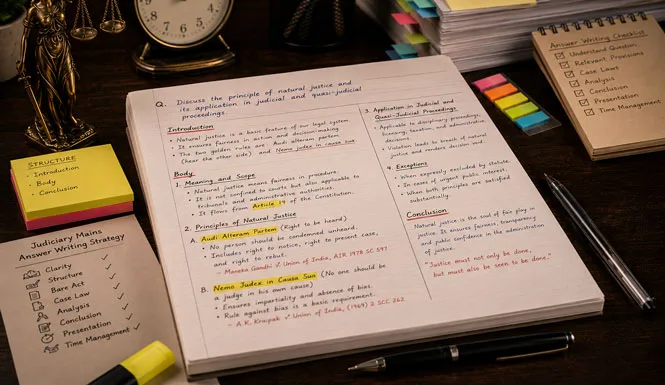
One of the most effective strategies for judiciary mains is maintaining a consistent structure in every answer. A scattered answer confuses the examiner and reduces marks even if the content is good. Most successful candidates follow either the Introduction–Body–Conclusion method or the IRAC method.
The Introduction should briefly introduce the legal issue, relevant provision, or principle involved in the question. It should not be excessively long because judiciary mains papers contain many questions and time remains limited.
The Body is the most important part of the answer. This section should contain statutory provisions, ingredients, explanations, exceptions, illustrations, and case laws wherever relevant. Answers should move logically from one point to another. Proper paragraphing and subheadings improve readability significantly.
The Conclusion should briefly summarise the legal position or provide a judicially balanced final observation. A concise and mature conclusion leaves a strong impression on the examiner.
Bare Acts Should Dominate Your Answers
The backbone of every high-scoring judiciary mains answer is the Bare Act. Many aspirants write general theoretical answers without mentioning precise statutory provisions. This weakens the answer immediately. A judicial officer is expected to know the law accurately, and the mains examination reflects that expectation.
Whenever possible, mention relevant sections, articles, provisos, explanations, or illustrations. However, merely reproducing the Bare Act mechanically is not enough. The provision should be explained and connected to the issue asked in the question. Examiners reward answers that demonstrate understanding rather than memorisation.
Practice Writing Like a Judge, Not a Student
A strong judiciary mains answer reflects balance, objectivity, and legal reasoning. Emotional language, dramatic expressions, or personal opinions should generally be avoided. The tone should remain formal, precise, and judicial.
Aspirants should cultivate the habit of writing analytical answers rather than descriptive ones. For example, if a question from constitutional law is asked, the answer should not merely define the provision but also explain judicial interpretation, and constitutional significance. The examiner should feel that the candidate understands how law functions in practice.
Presentation Matters More Than Aspirants Realise
In judiciary mains, presentation can directly influence marks. Examiners check hundreds of answer sheets continuously, and well-presented answers naturally create a better impression. Neat handwriting, proper spacing, underlining important keywords, and maintaining margins improve readability considerably.
Subheadings make answers easier to evaluate. Underlining sections, legal principles, and case names helps the examiner quickly identify valuable content. Long unbroken paragraphs should generally be avoided because they make answers appear cluttered and difficult to assess.
Time Management Is the Real Game Changer
One of the harsh realities of judiciary mains is that many candidates fail not because they lacked knowledge, but because they could not complete the paper properly. Writing one excellent answer while leaving two questions incomplete is disastrous.
Aspirants should practice writing answers within strict time limits from the beginning of preparation. Initially, quality should be prioritised, but eventually speed must improve. Most toppers recommend regular timed practice because speed develops gradually through repetition.
Daily Answer Writing Is Non-Negotiable
Judiciary mains answer writing is a skill, and like every skill, it improves only through repetition. Many aspirants keep reading theory for months but avoid actual writing practice. This creates a major problem because legal understanding alone does not automatically translate into effective answers.
Writing daily answers trains the brain to organise thoughts quickly under pressure. It improves legal articulation, speed, structure, and confidence simultaneously. Even writing two or three answers daily can gradually transform performance over a few months.
Conclusion
The best answer writing strategy for judiciary mains is not based on shortcuts or decorative techniques. It is built on clarity, structure, legal precision, and disciplined practice. A high-scoring answer is one that directly addresses the question, cites the relevant law, applies legal reasoning properly, and remains concise yet analytical.
Judiciary mains ultimately rewards candidates who combine strong legal knowledge with practical writing ability. Consistent answer writing practice, proper use of Bare Acts and case laws, structured presentation, and effective time management gradually shape an aspirant into someone capable of thinking and writing like a future judge.
Other Blog Posts