
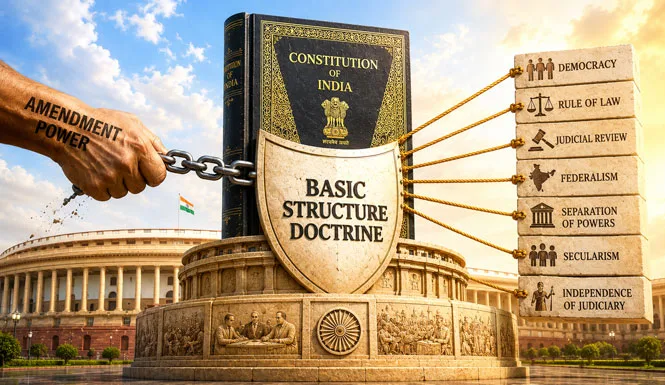
The doctrine emerged as a judicial response to an intense constitutional conflict between Parliament and the Supreme Court regarding the extent of Parliament’s amending powers. Over time, it became the constitutional shield that protects Indian democracy from authoritarian constitutional changes.
Origin of the Doctrine
The Basic Structure Doctrine was formally established by the Supreme Court in the landmark case of Kesavananda Bharati v. State of Kerala (1973).
Before Kesavananda Bharati, there was a long constitutional struggle over whether Parliament could amend Fundamental Rights. In cases such as Shankari Prasad, Sajjan Singh, and Golaknath, the Supreme Court gave differing interpretations regarding Parliament’s amending powers.
Finally, in 1973, a thirteen-judge bench of the Supreme Court delivered the historic judgment in Kesavananda Bharati. The Court held that Parliament possesses very wide powers to amend the Constitution, but it cannot alter the “basic structure” or “basic features” of the Constitution.
Why Was the Doctrine Needed?
The doctrine emerged because the Supreme Court feared that unlimited amendment powers could allow a temporary political majority to destroy the democratic and constitutional character of the nation.
If Parliament possessed completely unlimited power, it could theoretically:
- abolish elections,
- end judicial review,
- remove Fundamental Rights,
- establish dictatorship,
- or eliminate democracy itself.
The Basic Structure Doctrine prevents such constitutional destruction. The doctrine places “substantive limits on the amending power.” In other words, constitutional amendments are allowed, but only up to a certain constitutional boundary.
What Constitutes the Basic Structure?
The Supreme Court never provided a complete or exhaustive list of basic features. Instead, the doctrine evolved gradually through different judgments. Over time, the following principles have been recognized as part of the basic structure:
- Supremacy of the Constitution
- Rule of Law
- Judicial Review
- Separation of Powers
- Federalism
- Secularism
- Democracy
- Free and Fair Elections
- Independence of Judiciary
- Parliamentary System
- Dignity and Liberty of Individuals
- Unity and Integrity of India
These principles are considered essential to the constitutional identity of India.
The Doctrine as a Form of Judicial Review
The Basic Structure Doctrine is fundamentally a doctrine of judicial review. It allows courts to examine constitutional amendments and determine whether they damage or destroy essential constitutional principles. The doctrine evolved into “an independent and distinct type of constitutional judicial review.”
This means the Supreme Court does not merely examine whether a constitutional amendment follows procedure. It also examines whether the amendment violates the foundational philosophy of the Constitution. Thus, even constitutional amendments passed with huge parliamentary majorities can be struck down if they violate the basic structure.
Important Cases After Kesavananda Bharati
After Kesavananda Bharati, the doctrine was repeatedly applied and strengthened by the Supreme Court.
In Indira Nehru Gandhi v. Raj Narain, the Court held that free and fair elections are part of the basic structure. Parliament had attempted to immunize the Prime Minister’s election from judicial review, but the Court struck down the amendment.
In Minerva Mills v. Union of India, the Court invalidated parts of the 42nd Constitutional Amendment which attempted to give unlimited amending power to Parliament. The Court held that limited amending power itself forms part of the basic structure.
In S.R. Bommai v. Union of India, secularism and federalism were recognized as essential constitutional principles protected by the doctrine.
Thus, the doctrine gradually evolved from a theory into a central constitutional safeguard.
Criticism of the Doctrine
The Basic Structure Doctrine has also faced criticism. Critics argue that the doctrine is anti-democratic because unelected judges can invalidate constitutional amendments passed by elected representatives. Some scholars claim that the Constitution nowhere expressly mentions the phrase “basic structure.” Many critics viewed the doctrine as “counter-majoritarian” because it limits parliamentary authority.
However, supporters argue that democracy does not merely mean majority rule. Constitutional democracy also requires protection of liberty, institutional balance, and rule of law. The doctrine ensures that temporary political majorities cannot permanently damage the constitutional order.
Importance of the Doctrine
The Basic Structure Doctrine can be described as the constitutional conscience of India.
It has protected:
- judicial independence during political crises,
- democratic elections during authoritarian tendencies,
- federalism against central overreach,
- and constitutional supremacy against absolute parliamentary power.
The doctrine transformed India from a system of parliamentary supremacy into a system of constitutional supremacy. Today, it remains one of the most powerful contributions of the Indian Supreme Court to global constitutional jurisprudence.
Conclusion
The Basic Structure Doctrine represents a constitutional idea: that certain principles are so fundamental to the identity of the Constitution that even Parliament cannot destroy them. The doctrine ensures that constitutional amendments remain constitutional in spirit, not merely in procedure. It protects the Constitution from becoming a tool of authoritarian power and preserves the democratic framework envisioned by the framers of the Constitution. The doctrine reminds us that while governments may change and political majorities may shift, the foundational values of the Constitution must endure.
Other Blog Posts